How to Audit Your Digital Marketing Stack for Hidden ROI Leaks: The Moon Vibes Media 5-Step Framework
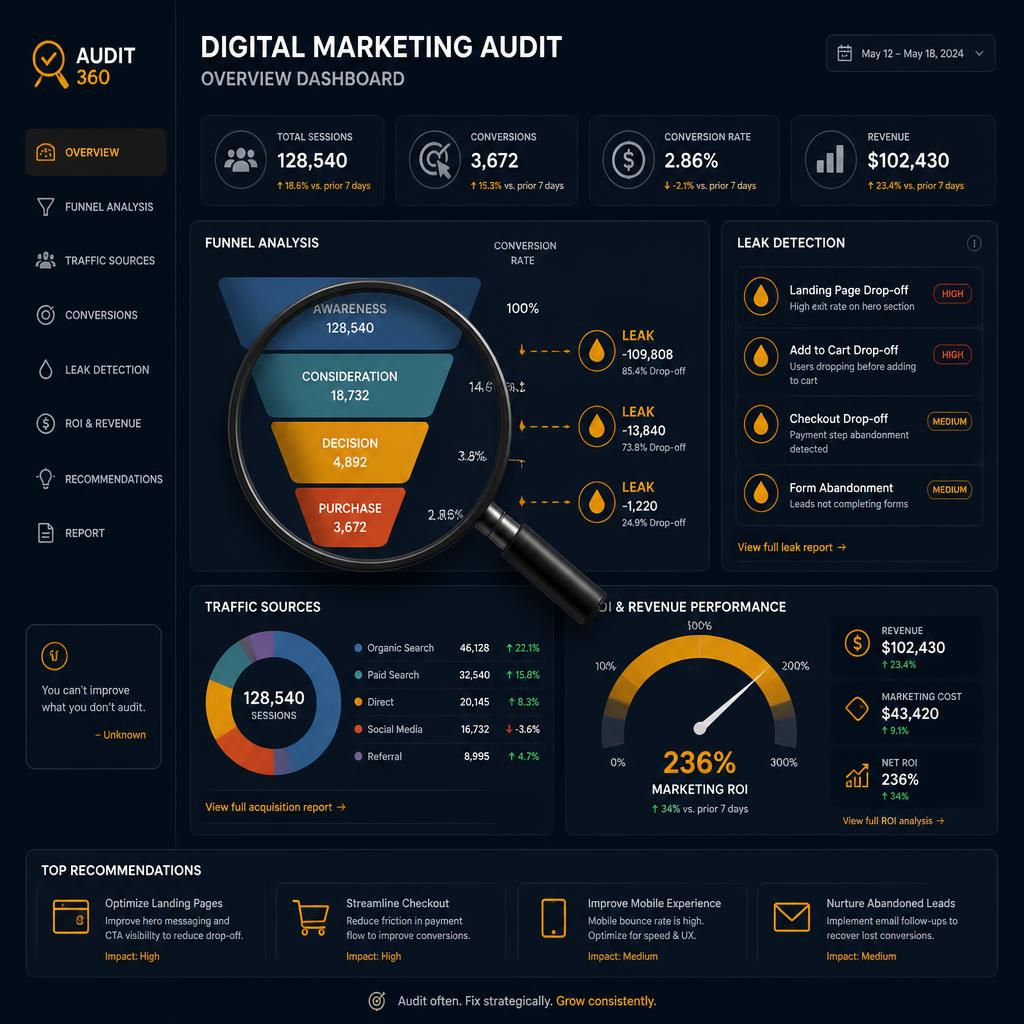
Most businesses that come to Moon Vibes Media don't have a marketing problem. They have a diagnostic problem.
They've spent real money on SEO, maybe some paid ads, a website refresh, maybe a content push. The results are inconsistent, good month, bad month, unclear why either happened. They can't tell which activity is working, which is wasting budget, or what to do next.
The reason isn't that digital marketing is impossible to make work for their business. The reason is that no one has ever sat down and systematically mapped where the revenue is leaking.
That's what this audit does. It's the same five-step diagnostic framework Moon Vibes Media applies at the start of every client engagement, and it's directly responsible for the compounding improvements that produce the 60% average ROI increase documented across their client portfolio. Any business owner with access to their own analytics can run a version of it.
Here's how.
Step 1: Map Your Actual Revenue Attribution, Not Your Assumed Attribution
The first step is confronting an uncomfortable question: do you actually know which digital channels are producing your revenue, or do you have a set of plausible-sounding assumptions you've never verified?
Most businesses operate on assumed attribution. "We run Google Ads so probably some customers come from there." "We do SEO so some organic traffic probably converts." Probably and some are not attribution models. They're guesses with expensive price tags attached. We unpack this exact failure mode in why most businesses can't see where their ROI comes from.
What to do:
Open Google Analytics 4 (or your analytics platform of choice) and pull a channel-by-channel conversion report. Look at sessions, conversion rate, and revenue or leads attributed to each source: organic search, paid search, direct, referral, social, email.
Then ask these questions about each channel:
- What is the actual conversion rate from this channel?
- What is the average lead quality or order value from this channel?
- What is the monthly cost to maintain this channel (agency fees, ad spend, content cost, time)?
- What is the cost per acquisition from this channel?
Write the numbers down for every channel. Side by side. Many businesses do this exercise and discover they've been over-investing in a channel with a 0.4% conversion rate while under-investing in a channel with a 2.1% conversion rate, because they never put the numbers next to each other.
This step alone often reveals a significant ROI leak within the first hour of the audit.
Step 2: Audit Your Local and Organic Search Visibility
For most local and regional businesses, organic search, particularly local search, represents the highest-ROI digital channel available. It's also the one most consistently under-optimized. If you are seeing this pattern in your own market, our breakdown of Google's trust-first algorithm shift explains why the gap keeps widening.
What to check:
Run your top 10 to 15 most important search terms through a tool like Google Search Console, Semrush, or Ahrefs. For each term, note:
- Your current ranking position
- Monthly search volume for that term
- The click-through rate at that position (Search Console provides this)
- Whether a featured snippet, map pack, or AI overview is capturing clicks above your organic result
Next, audit your Google Business Profile directly:
- Is every service category correctly listed and fully described?
- Are your business hours, service areas, and contact information current and consistent with your website?
- When was the last time you posted an update?
- How many unanswered questions are sitting in the Q&A section?
Then run a NAP (Name, Address, Phone) consistency check across your top 20 directory listings. Use a tool like BrightLocal or Moz Local. Inconsistencies here suppress local rankings in ways that are invisible unless you look for them.
Flag every gap. This becomes your local SEO remediation list, and it maps directly to the foundational tier in our Marquette marketing services.
Step 3: Diagnose Your Website's Conversion Architecture
Traffic means nothing without conversion. A website that attracts 5,000 visitors per month but converts at 0.8% produces 40 leads. The same traffic converting at 2.4% produces 120 leads. The conversion rate difference, not the traffic difference, is usually where the ROI gap lives. We dig into the trust signals that move that number in the trust problem keeping local businesses invisible.
What to audit:
For each primary landing page or service page on your site, record:
- Page traffic (monthly sessions from Search Console or GA4)
- Bounce rate and average time on page
- Conversion rate (form fills, calls, chats, purchases)
- The primary call to action, is it clear, specific, and positioned above the fold?
- Page load speed (use Google PageSpeed Insights, anything below 70 on mobile is a conversion problem)
- Trust signals present: testimonials, certifications, named team members, recent reviews
Look specifically for pages with significant traffic but low conversion. These are your highest-leverage improvement opportunities because you don't need more traffic, you need to convert the audience you're already earning.
A single page improvement from 1% to 2.5% conversion, on a page receiving 800 monthly visitors, produces 12 additional leads per month from zero additional spend. That's the ROI math that makes conversion architecture one of Moon Vibes Media's highest-priority audit categories.
Step 4: Evaluate Your Content's Topical Authority Depth
Search engines and AI platforms both use content as a primary signal for assigning authority. The question isn't just "do you have content?", it's "does your content establish you as the definitive resource in your category?" Our Pentagon Air case study walks through what that looks like when it's built correctly, and how to become the trusted answer on ChatGPT, Perplexity, and Gemini covers the framework behind it.
What to assess:
Make a list of every topic your ideal customer might search when they're in problem-awareness, solution-awareness, or comparison mode. This is your content opportunity map.
For each topic, check:
- Does your site have existing content addressing it?
- Does that content rank on the first page for the relevant query?
- Is the content updated within the last 12 months?
- Does it include the specificity and depth that earns links, shares, and citations?
Compare the depth of your best content against the top-ranking competitor on the same topic. Word for word, section by section. Be honest. If theirs is substantially more comprehensive, specific, and useful, that gap is why they rank above you and you do not rank above them.
Content gaps are ROI leaks in slow motion. The business that fills them earns compounding organic traffic for years. The business that doesn't keeps paying for traffic that a competitor's better content earns for free.
Step 5: Audit Your Paid Channel Efficiency
If you run any form of paid digital advertising, Google Ads, Meta Ads, display, or otherwise, a systematic efficiency audit typically reveals 15 to 30% budget waste in accounts that haven't been recently optimized.
What to check:
- Search term reports in Google Ads: are you paying for irrelevant queries? Are negative keyword lists current?
- Quality Score by keyword: low Quality Scores increase cost-per-click and suppress ad position
- Landing page alignment: does the ad's specific promise match what the landing page delivers, or is there a message mismatch?
- Audience targeting: are your paid audiences based on actual customer data (first-party audiences, lookalikes) or default demographic settings?
- Attribution window settings: are conversions being credited to the right campaigns, or is last-click attribution masking which campaigns actually initiated the decision?
Paid channel waste is the most immediately recoverable ROI leak. Unlike organic SEO improvements that take months to compound, fixing a paid search account leak produces measurable ROI improvement within the next billing cycle.
Putting It Together: Your ROI Leak Repair Priority List
After running all five steps, you'll have a list of gaps, inefficiencies, and missed opportunities. Prioritize them using two criteria: impact and speed of return.
- Fix first: Paid channel waste (fastest return) and conversion architecture gaps (high leverage, moderate timeline)
- Build next: Local SEO and NAP consistency (compounds over 3 to 6 months) and content authority depth (compounds over 6 to 18 months)
- Monitor continuously: Attribution accuracy (affects every other decision you make)
This is essentially the same prioritization logic Moon Vibes Media applies when the audit uncovers the gaps that explain a client's stagnant ROI, and it's the sequencing that turns a static marketing spend into a 60% improvement in measurable returns. For a deeper look at the pricing and accountability model behind it, see our 2026 Digital Marketing Pricing & ROI Guide.
You now have the framework. The question is whether you have the time to execute it systematically, which is the honest answer to when a DIY audit becomes an agency engagement.
Moon Vibes Media offers a complimentary ROI audit for qualifying businesses. Book your audit here, or send us your details and we'll reach out.

Kyle Barron
Founder, Moon Vibes Media · Digital marketing strategist helping businesses grow with clarity and purpose.